


The Data Foundation Accelerator helps organizations move from scattered spreadsheets and stalled pilots to a governed Microsoft Fabric data foundation in 90 days. Learn how DFA creates the structure, milestones, and operating model needed for AI-ready data.

Most of the time, we don’t see data modernization efforts stall due to a lack of tools. We see them stall for lack of a finish line.
Organizations buy the platform, light up Microsoft Fabric, test a few things, and then wait. Capacity sits idle. The pilot never graduates. The governance program is always coming down the road. No one defined what “done” looks like, or by when.
The Data Foundation Accelerator (DFA) is a minimum viable modern data platform you can deploy in minutes on Fabric and Azure. After that, we guide customers through a prescriptive 90-day program that takes a team from scattered spreadsheets to chatting with governed data.
Crawling comes fast. Walking follows quickly. Running takes a little longer, but once you’re running, it’s easy to stay at speed. A few days to crawl. About thirty more to walk. Within forty-five days, you should be running.
Is your data platform something you operate every day, or something you’re still planning to start?
About the Program
This program isn’t a longer statement of work. It’s a shorter one with fixed milestones, defined deliverables, and clear exit criteria at every gate. You always know what phase you’re in, what “done” looks like, and what unlocks the next step.
The structure means that open-ended data projects won’t drift. Most often, these programs won’t crash; they fade. A pilot that never earns a production decision is just a more expensive spreadsheet.
DFA replaces “we’ll figure it out as we go” with a runbook. Deploy. Learn. Govern. Productionize. Every step has a date attached.
If your last data pilot is still a pilot, what was the milestone that was supposed to end it?

A 90-Day Program at a Glance
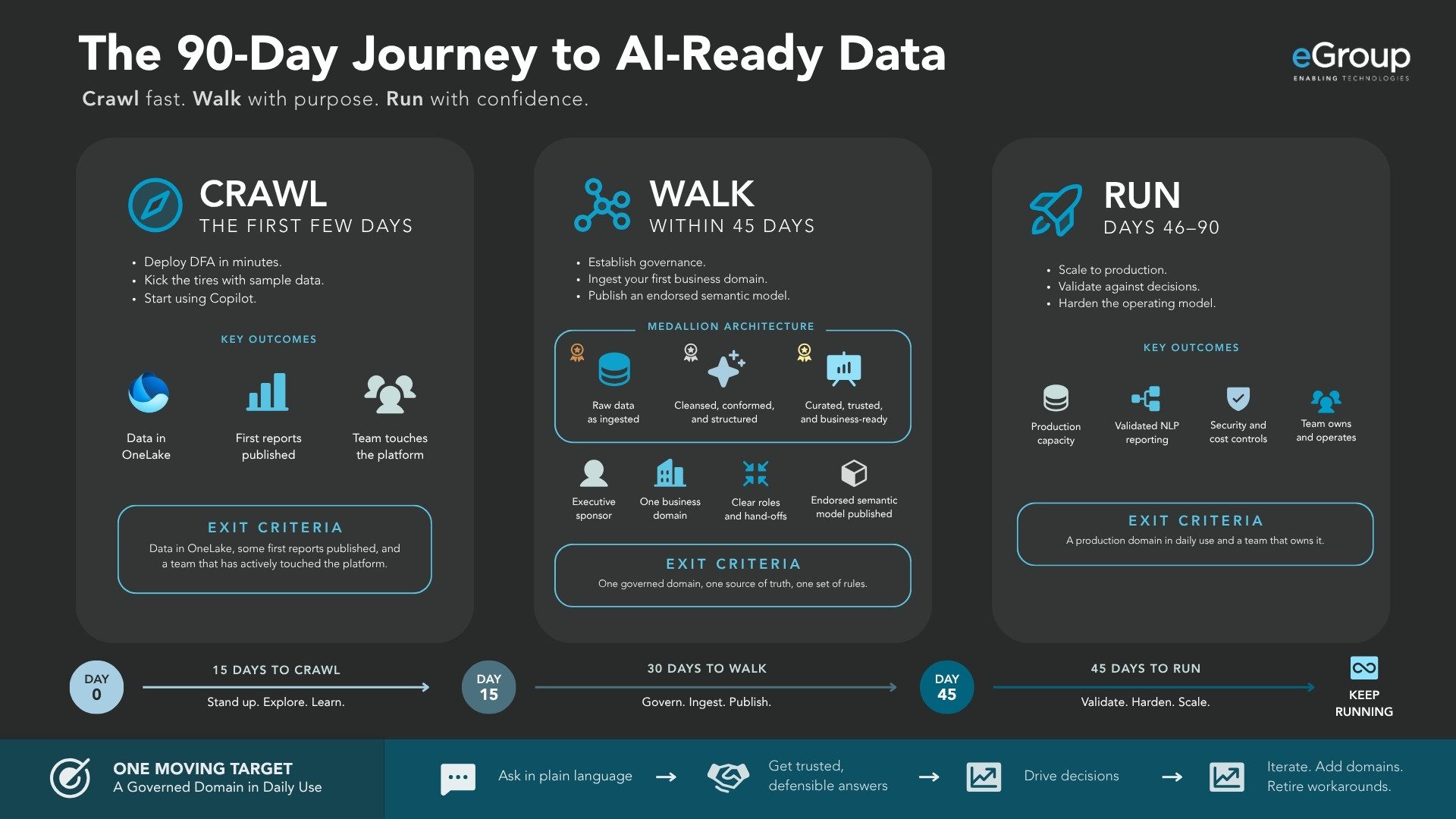
Three phases, ninety days, one moving target: a governed domain in daily use.
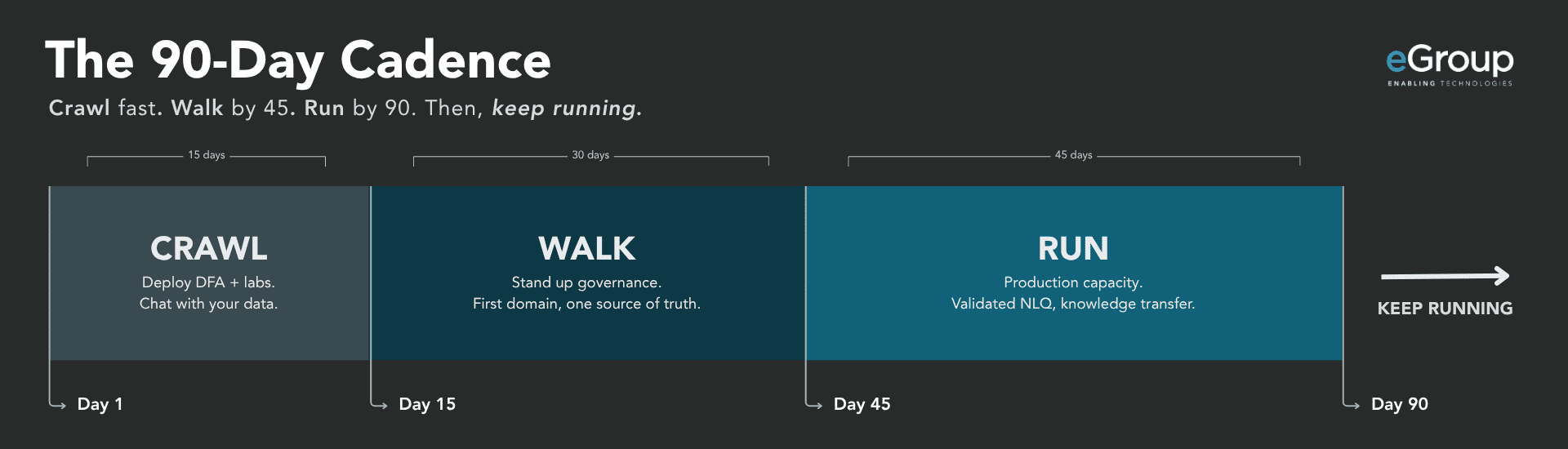
Crawl: Deploy and Explore
Deploy DFA from the Azure Marketplace and stand up an ungoverned Fabric workspace in minutes. Run the self-guided labs to kick the tires with some sample data and start using Copilot to chat with your data. Fabric’s trial capacity means you can start crawling today, before any procurement conversation.
Exit criteria: data in OneLake, some first reports published, and a team that has actually touched the platform.
Walk: Govern One Business Domain
Start working up the data governance program: one executive sponsor, one domain, with clear roles and clean hand-offs. Ingest your first real business domain through repeatable medallion patterns: bronze → silver → gold. Publish an endorsed semantic model so business users can ask questions in plain language and trust the answer. You don’t need a perfect program on day one; you need a working one.
Exit criteria: one governed domain, one source of truth, one set of rules.
Run: Productionize and Scale
Scale up to the production capacity, validate natural-language reporting against real decisions, and harden the operating model: security, cost monitoring, and knowledge transfer so the team can carry it forward.
Exit criteria: at least one production domain in daily use and a team that owns it. The entire environment has reached a governed state.
After day 90, running becomes the baseline. Each cycle adds a domain, retires a workaround, and standardizes another report. Iterative data modernization becomes a regular exercise that keeps the program healthy.
A data program is never “done.” It’s either getting healthier or getting out of shape.

What Done Looks Like at Day 90
At the end of the program, a team has more than infrastructure. They have:
- A governed Fabric workspace with an endorsed semantic model that business users can trust.
- Production data domains feeding real operational decisions and not just a Fabric sandbox.
- Validated natural-language reporting: anyone with Fabric access, capacity, and Copilot can ask a question in plain language and get a defensible answer. The business user is now a first-class data consumer and no longer relies on others for reports.
- A running governance program that scales by adding domains.
- A team that can operate and extend the platform without depending on outside help for every change. This can compound as the goal was never to deliver a new, shiny dashboard. It was the capability that empowered business users to make decisions.
When a business leader asks a new question of your data, is the answer hours away — or a sentence away?
Why the Foundation Comes First
AI can’t outrun the data underneath it. If the foundation is scattered, inconsistent, or unreliable, no model on top will save the outcome.
- 45% of business leaders cite data accuracy and bias as the leading barrier to scaling AI. (IBM Institute for Business Value, January 2026)
- 44% of small and midsize businesses report data inconsistencies across systems. (Salesforce SMB Trends Report, 6th Edition, 2025)
The upside of fixing it is just as measurable: organizations that modernize data and apps on Microsoft report a 344% three-year ROI and execute business change 78% faster. (IDC Business Value, April 2025)
Bad data leads to bad decisions. A governed foundation is what turns AI from a demo into a dependable input to decisions.


A Practical Customer Example
A federal-adjacent nonprofit intermediary came to us with data scattered across three systems: a customer CRM, a financial ERP, and an on-prem operations database that drove their largest external-reporting obligation. Every reporting cycle, analysts manually reconciled the CRM and the operations database to produce a single dashboard. An earlier Azure Synapse lake had become another silo rather than a source of truth.
Inside the 90-day window, the team stood up and accepted a governed Fabric architecture organized around a bronze → silver → gold medallion, with nine workspaces spanning development, test, and production. Right-sizing took the initial capacity proposal from F256 down to F64 in production and F32 in non-prod, a meaningful reduction before a single dashboard changed. Phase 1 implementation kicked off on schedule, with the external-reporting dashboard sequenced as the first production domain to cut over.
What changed wasn’t just the architecture. It was the cadence. The team now has a runbook for the next domain, rather than debating where to start.
What to Do Now
Deploy and crawl this week. The self-guided labs and steps are on GitHub. Spin up trial capacity if you don’t already have one, run the labs, then put your own data in front of Copilot. You’ll learn more in an afternoon of kicking the tires than in a month of slideware.
Name a sponsor and a domain. The best predictor of a program reaching “run” is an executive sponsor who owns a single business domain end-to-end. Start there. Prove it. Then scale.
Both are small commitments that decide whether you’re running or still planning ninety days from now.


How eGroup Helps
DFA gets you a modern, unified data platform in minutes. The 90-day program is how eGroup turns that platform into an operating data program — advisory sessions to decide business outcomes, configured Fabric workspaces with endorsed semantic models, validated reporting and natural-language scenarios, and ongoing services so our team can run with you.
If you can deploy in minutes, the only real question is whether you’ll still be “planning to start” ninety days from now.
Starting costs less than most teams expect. Microsoft incentive programs through partners like eGroup can offset much of the work: the Data/AI Modernization Frontier program offers funding for qualifying Fabric, SQL, and Foundry projects, and Azure Accelerate can fund assessments and environment setup. Incentive eligibility and amounts may vary – we can help you determine what you qualify for.
Start Your Data Foundation Journey
Move from disconnected data and stalled pilots to a governed Microsoft Fabric foundation your business can trust, extend, and use.