


AI ownership is no longer just a technology decision. SMB leaders need a shared operating model that connects executive sponsorship, secure platforms, business accountability, cost controls, and measurable outcomes.

For small and midsize businesses, the conversation about AI is moving from experimentation to economics. The first wave was simple… buy licenses, find enthusiastic users, and see what happens! The next wave is proving to be harder. AI costs are becoming more variable, agents are performing meaningful work, and leadership teams must decide who owns the strategy, risk, and the checkbook.
Significant Statistics
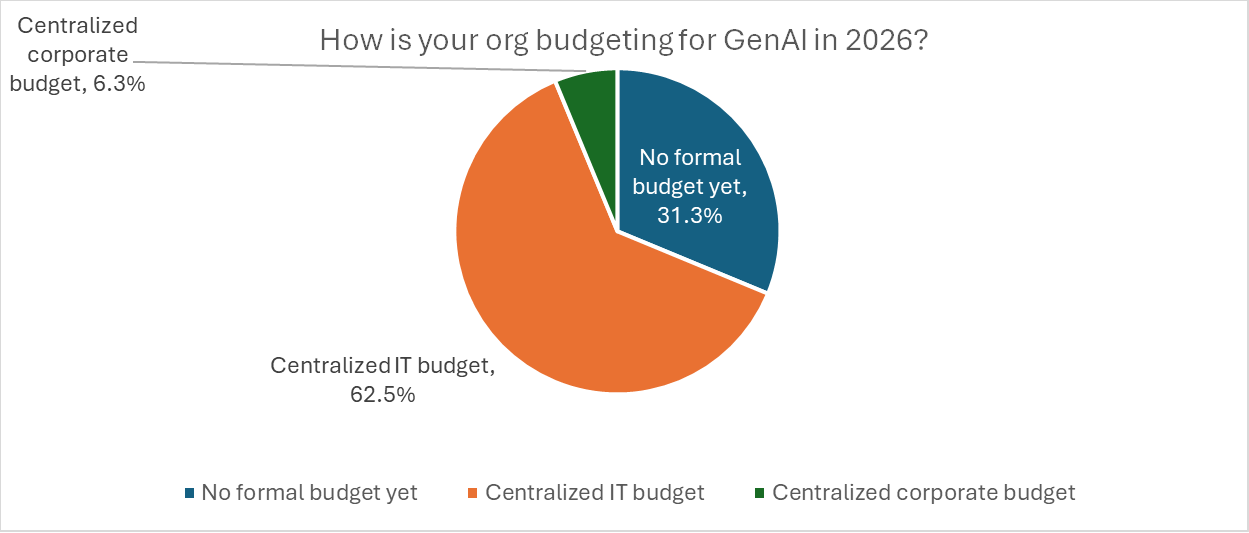
Our recent GenAI for Executives survey shows where many organizations stand. Sixty-three percent of respondents said their 2026 generative AI budget sits in IT, while 31 percent still have no formal budget. Only 6 percent fund AI through a centralized corporate budget.
At the same time, 70 percent said their CEO actively owns AI as a strategic priority.
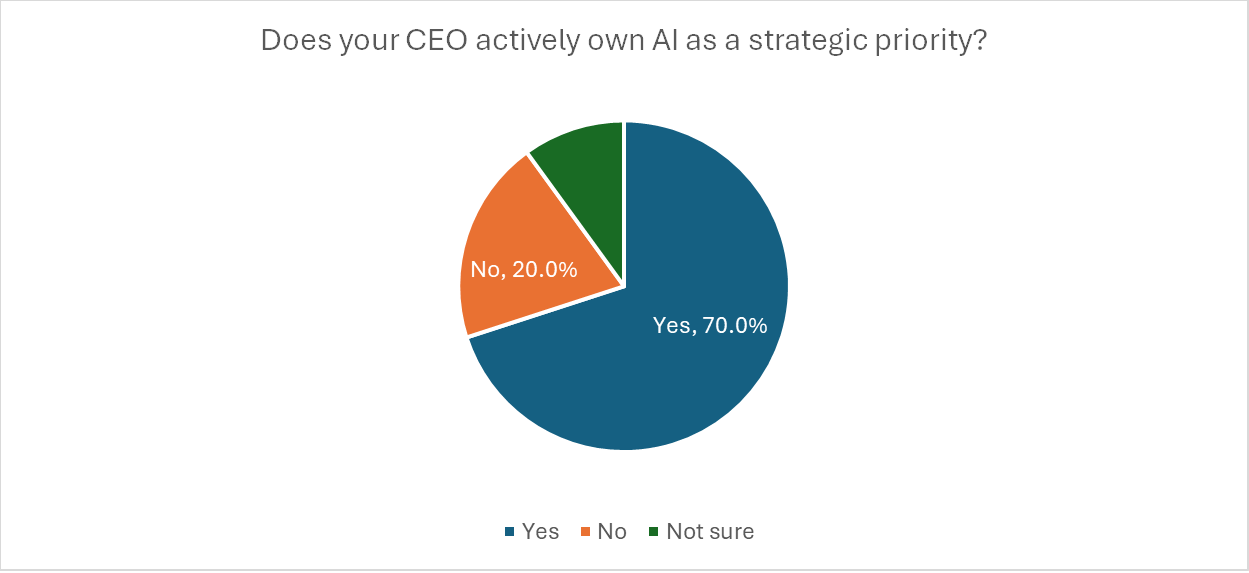
That is encouraging, but it exposes an interesting risk. Executive sponsorship seems to be forming faster than the financial and operating model needed to support it. When AI is strategically important but funded mainly as an IT expense, the business risks treating adoption as a technology rollout instead of a change in how work gets done.
Technology rollouts eventually hit walls, sputter, then restart when something new comes along. AI is too fundamentally game-changing to risk falling into that trap. AI will have its fits and starts, but the answer is not to push ownership entirely onto the CFO or pull it away from IT. Successful adoption requires shared accountability.
CxOs’ Roles
The CEO should set the expectation that AI will change how the company operates. See my interview with CEO Dana Anderson as an example. The CFO should define how value, cost, and risk will be measured. CIOs should establish a secure platform, govern access, and provide visibility into usage. COOs and business leaders should own the workflows and measure the outcomes. Security, legal, and data leaders should set boundaries for responsible use.


A Proposed Method to Share the Costs
The budget should reflect the same division of responsibility. A practical structure is a two-tier model. IT funds a baseline of approved tools that gives employees a governed alternative to consumer AI services. Departments then fund premium licenses, usage-based services, and agents tied to their workflows. Investments in data protection, identity, training, and governance remain shared infrastructure and central. This two-tier approach was a central theme of the executive discussion.
This gives the business room to experiment without turning IT into an unlimited subsidy. It creates a natural decision point. When a department wants an advanced agent or high-volume service, it must define the process being improved, expected benefit, accountable owner, and spending limit.
Cost Discipline Back En Vogue
The mid-2026 (Pay-As-You-Go era) survey suggests that cost discipline is paramount. Forty-two percent of respondents expect the largest share of their AI budget to go toward licenses and tokens. Security and compliance followed at 25 percent, while adoption and organizational change received 17 percent. Process redesign and data optimization each received only 8 percent.
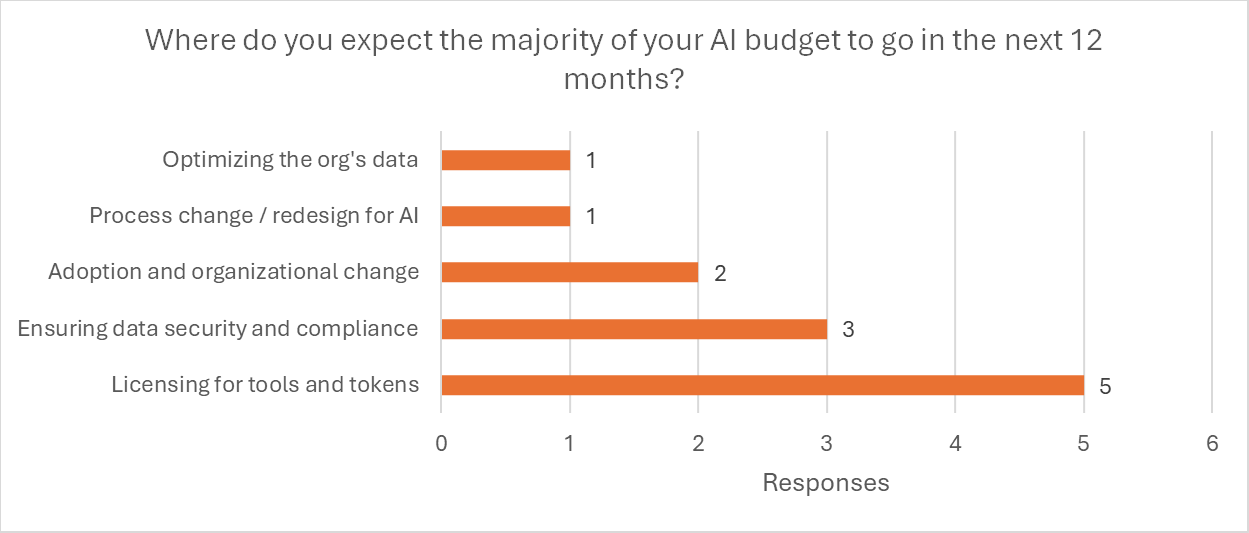
What a difference tokenomics makes! In a similar survey in February (pre-PAYG era), CFOs surveyed said that only 9% of their budgets were allocated on licensing. Pay as you go has clearly changed the mindset.
Measuring Success
The first round of evaluating GenAI’s ROI was on individual time saved. There are significant success stories. There’s a risk in continuing along those lines. One, the law of diminishing returns. Paying just as much for Pay as You Go (with Cowork) may be less dramatic of a workflow improvement than general-purpose AI was.
Secondly, tech cannot put bandaids on poorly operating business processes. Companies may spend heavily on AI tools while underinvesting in the work required to turn technology into business value. A license can help an individual draft, summarize, or analyze faster, but there will eventually be a wall.
Larger returns require a team to redesign a process, connect reliable data, clarify decision rights, and measure the result end to end. Examples include Verdantas’s reengineering of their “pursuits” process, which ended up shaving 10-14 days’ worth of work down to less than one day.
While it’s easy to measure ROI based on hours saved, more meaningful scorecards include cycle-time reduction, increased capacity, avoided cost, improved quality, faster revenue, lower risk, and better customer outcomes.


Governing Agentic AI
AI agents make ownership even more important. Every production agent should have an accountable business owner, a defined purpose, approved data boundary, budget, and a regular evaluation process. Models and underlying services change. So too, do their costs and efficacy. Much like data needs an owner, so do agents.
The line of business cannot wait for perfect data hygiene. In our survey, 54 percent said they had started a data loss prevention rollout, while 46 percent had not. Most organizations are advancing AI adoption and data protection in parallel. This phased approach recognizes that waiting for perfect governance can stall adoption indefinitely. Agents and limiting SharePoint permissions are two ways to proceed in earnest with GenAI without waiting for data perfection.
Summary
For SMB leaders, the strategic question is not whether AI belongs to IT or the business. It belongs to the operating model. Companies that manage it well will connect executive sponsorship, financial discipline, secure platforms, process ownership, and measurable outcomes.
Start with a small portfolio of use cases that can produce visible business results. Fund the baseline centrally. Charge advanced consumption to teams receiving the value. Give every agent an owner. Review cost and outcomes together.
AI at scale will not be won by the company with the most licenses. It will be won by the company that knows what it is paying for, who is accountable, and which business result should improve.


Build Your AI Operating Framework
Define how your organization will govern AI ownership, funding, risk, agents, and measurable business outcomes.